 |
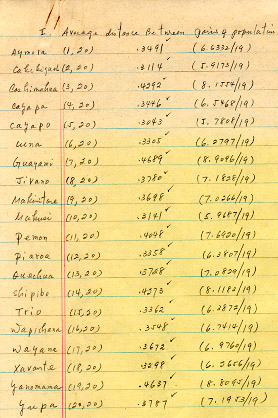
Fig. 1: Notes of genetic distance between populations
of Amazonian Indians
From |
A source of pleasure for curators and researchers alike, acquisitions are the heart and soul animating the manuscript department. As might be expected from our experience in recent years, the history of genetics headed the acquisitions slate. The papers of the pioneering human geneticist and radiation biologist, James V. Neel, arrived in May, 1999, and were followed one year later by the papers of the great
Drosophila geneticist, Bentley Glass, and in December, 2000, by the papers of another drosophilist, Frances E. Clayton. The Neel, Glass, and Clayton Papers are described in the last two issues of the
Mendel Newsletter. As we hope, the APS will continue to enhance its reputation as the premier institution in the country for study of the history of the evolutionary sciences.
The Society's strength in Native American studies also continued to wax. The regular flow of materials from Phillips Fund grants was supplemented by a torrent of material, headed by the arrival of the Frank Siebert papers from Maine. A large and important collection for the study of Native American linguistics and culture, the papers are the product of nearly sixty years of research (1930s-1990s) conducted by an avocational linguist among the Penobscot, Catawba, and Delaware Indians, and include some scarce recordings and transcripts of native speakers of Penobscot. Siebert was also a collector of rare books and manuscripts, although these were not part of his bequest to the APS, and at the first of two sales of his library at Sotheby's, the library purchased three important letters written by the Moravian proto-ethnologist, J. G. E. Heckewelder. Adding further depth to the library's holdings in Native American history and languages were a substantial addition to the papers of the University of Pennsylvania ethnohistorian, Anthony F. C. Wallace, and somewhat smaller additions to the papers of anthropologists William N. Fenton and Carl Voegelin.
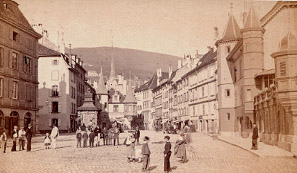 |
Fig. 2: Reu de Neuchatel, geneva, ca.1875
From European photo album in Kane Family Papers |
Proving that the dawning of the new millennium does not entail the setting of the old, the manuscripts department received two large and exciting -- and thoroughly unexpected -- additions to existing collections. Mrs. Henry Meigs donated the remaining papers of the Hare and Willing families, nearly 30 linear feet of material that adds the capstone to our already extensive holdings for Robert Hare and his relatives, extending those holdings into the late 19th and early 20th centuries. Even more unexpected was the arrival of 12.5 linear feet of materials of the Kane family, transferred to the APS in May, 2000, by the Rhode Island Historical Society. Although the collection contains relatively little respecting the two best known Kanes -- John Kintzing and Elisha Kent - the new addition doubles the holdings for Elisha's brother, Thomas Leiper Kane, best known for his role in attempting to prevent the Mormon War of 1858, and for his nephew, Francis Fisher Kane, a prominent, socially liberal attorney. Equally exciting is a strong body of material pertaining to Francis' sister, Eliza Kane Cope.
Several miscellaneous and smaller collection arrived during the period, as usual. The most distinctive lot was a small clutch of family letters donated to the Society by Mr. and Mrs. Francis H. Bohlen in October, 1999. Mr. Bohlen's ancestors, John Bohlen and Daniel Murray, were farsighted enough to correspond with the likes of Meriwether Lewis, Francis Scott Key, Oliver Hazard Perry, and Timothy Pickering, leaving a scant dozen glorious letters. Marc Willcox, a descendent of William H. Keating (APS, 1822) donated four bound volumes of manuscripts relating to his Keating ancestors, including a survey book and three cash books, while Linnea Layton donated the journal of her ancestor, John Carré, a refugee from revolutionary-era Saint Domingue and an educator in Philadelphia. Philip Klass contributed his usual round of books, videotapes, and manuscripts relating to UFO research, and Sabina Sanderson donated additional material from her late husband, the naturalist, Ivan T.
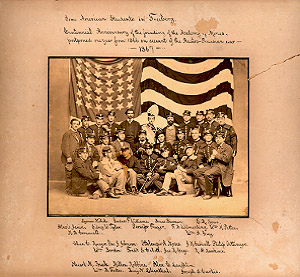 |
Fig. 3: American students in Freiburg, 1867
Persifor Frazer Papers |
Acquisition, as well as donation, helped build the collections in 1999-2000. The purchase of a small addition to the papers of geologist Persifor Frazer helped flesh out Frazer's interest in Egyptian antiquities. The Aemilius Irving Papers document the sugar trade in late 19th century Jamaica, the Joel Whitney Papers provide a Congregational missionary's perspective on Micronesia during the 1870s and 1880s, and the lecture notes of John A. Stevens, 1812, add depth to our expanding holdings documenting the academic study of natural philosophy. In natural history, too, the collections continued to expand with the "rediscovery" of the papers of the French naturalist, Victor Jacquemont (long misplaced), and the acquisition of the journals of the amateur ornithologist, Martin Trippe (1865-1870) and the entomologist, Wilbur King (1894-1904).